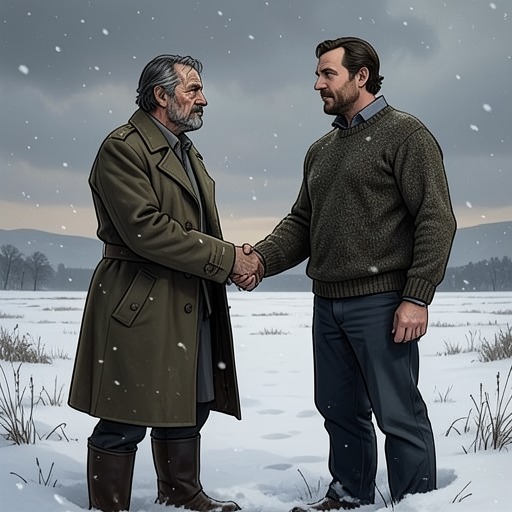
Colonel Miller and Jón’s relationship
Operation NapoleonColonel Miller and Jón’s relationship grew out of a wartime search on Vatnajökull Glacier and became a lasting bond of cooperation, discretion, and unresolved knowledge. Jón and his brother guided Miller’s soldiers across dangerous ice, welcomed the colonel into their home, and kept their promise not to reveal the expeditions’ true purpose. Their loyalty outlasted the first search, the brothers’ own speculation about the aircraft, and the years in which Jón was told that Miller had died.
The first expedition
At the end of the war, Colonel Miller led an American military expedition to find a German aircraft believed to have crashed on Vatnajökull Glacier. The force reached Höfn after a difficult journey around Iceland, then established its base at the brothers’ farm. Jón and his brother agreed to guide the soldiers despite warning that a winter search had little chance of success: fresh snow could conceal any trace of a crash, and the immense glacier made the task resemble searching for a needle in a haystack.
The brothers spoke no English, so their first working relationship with Miller depended on gestures and sign language. They showed him the direction of the aircraft and led the soldiers safely past crevasses and gullies, while Miller relied on their local knowledge. Although he understood their warnings, he pressed on with the search. The men found no aircraft, only the rim of its nose wheel about two kilometres onto the ice cap. Miller immediately took charge of the fragment. The brothers had examined it first and noticed lettering on the rim in a language they could not understand.
The search brought hardship as well as cooperation. The short winter daylight left little time on the ice, and severe weather disrupted the expedition twice. In the second storm, tents and equipment were buried and lost, forcing Miller to abandon the effort. The brothers nevertheless came to admire him: he seemed tireless, kept his men in order, and consulted them about the terrain. Their regard was personal as well as practical, though it did not make them blind to his determination to continue despite their warnings.
Private regard and repeated returns
One encounter at the farm gave the brothers a glimpse of a side of Miller that his command presence concealed. They found him alone in the stable, cradling and stroking a horse’s head as he wept. When he noticed them, he quickly dried his face and acted as if nothing had happened. He described the animal as handsome, though the brothers could not understand his words. They thought he might be homesick, but did not ask him about the incident. Its place in their memory suggests how closely they watched a man they respected, while also preserving the distance he maintained around his private feelings.
Miller’s connection with the brothers continued after the failed expedition. He returned to the farm every few years on his own, staying for two or three weeks and searching the ice cap with a small metal detector before going back to the United States. The visits kept the relationship alive beyond the military operations themselves: Miller and the brothers remained on friendly terms, and the colonel continued to depend on their familiarity with the glacier. When the brothers asked soldiers in the 1967 expedition about him, they were told that he was dead. Jón nevertheless retained the history of their friendship and the promise that had accompanied it.
A pact of discretion
Miller had asked the brothers to keep the true purpose of the searches secret. If local people became curious, they were to describe the activity as military training exercises. Jón and his brother honoured that request, even as the army returned in force whenever it believed aircraft wreckage was emerging from the ice. The brothers knew that the military monitored the glacier and had sometimes noticed surveillance flights, but they were not told what the plane carried or why it mattered so much.
Their silence did not mean that they had stopped wondering. In private, the brothers speculated that the aircraft might contain Jewish gold, diamonds, looted art, a senior German officer, or a secret weapon. These remained guesses, not knowledge. Jón later recalled that the 1967 expedition was the largest he had seen and that the military had acted on a satellite image showing part of the wreck. The shift from surveillance flights to satellite imagery altered how the army found signs of the aircraft, but not the secrecy that surrounded its searches. The brothers continued to guide the soldiers and to conceal what they knew about the expeditions, while the object of Miller’s commitment remained unexplained to them.
The secrecy was more complicated than the brothers could have known. Much later, Miller explained that only a tightly controlled number of people in the army knew about Operation Napoleon, and that even he had never known exactly what it involved or what the documents contained. He described himself and his brother as pawns assigned to a specific problem. The gap between Miller’s own limited knowledge and the brothers’ elaborate theories makes their pact a form of loyalty without full disclosure: they protected his confidence without possessing the answer they imagined he was withholding.
Memory, loss, and disclosure
Years later, Miller remembered the brothers as friendly, hospitable, cooperative, and, above all, discreet. He recalled their first meeting at the foot of the glacier and the way they had welcomed him and guided his men without demanding explanations. His memory returns the relationship to its beginnings, but also shows that the promise and the brothers’ discretion had become central to how he understood their bond. The report of his death in 1967 had not erased that connection; Miller’s later recollection confirms that he survived and continued to carry the brothers with him in memory.
Jón’s loyalty was tested when Kristín arrived seeking help after American soldiers had attacked her brother on the glacier. She accused Jón of having helped the soldiers over the years and connected his past cooperation with the danger facing her family. He had kept his promise even after his brother Karl died, but now had to weigh that old obligation against Kristín’s urgent need. He disclosed that the expedition leader was known as Ratoff, giving her a concrete lead while ending his silence about the operation’s current personnel.
Jón also brought out a battered metal case containing weather-damaged papers. The German typewritten documents had largely blurred or fallen apart, but the words “Operation Napoleon” could still be made out on one surviving piece. Jón had not removed anything from the case; he passed it to Kristín, who examined it. The papers did not resolve what Miller himself had never fully known, but their survival gave material form to the secret that had shaped the relationship for decades. Jón’s course from guiding Miller, to guarding his confidence, to helping Kristín shows both the durability and the limit of the old pact: it bound him for years, but did not prevent him from acting when its silence threatened someone in immediate danger.